


Love and Justice in Society: Embracing Our Shared Humanity is more than a title; it is a call to reflection and responsibility. Love and justice are not confined to moments, movements, or seasons—they are the moral foundation of how we are meant to live together. When we truly embrace our shared humanity, we recognize that dignity, fairness, and compassion are not optional ideals, but essential commitments that shape a more equitable and understanding world.
Justice grows from that same place. Justice is love that has decided to be responsible. It is love that understands fairness is not a favor and dignity is not a reward. Justice is the quiet insistence that every person deserves safety, respect, and opportunity simply because they exist.
And humanity is the bridge that connects us all. It reminds us that behind every label, background, belief, and body is a person who wants to belong, to be seen, to be heard, and to be valued. Humanity is what refuses to let us reduce one another to categories that are smaller than our souls.
But education matters here. Deeply.
Many people were never taught the fullness of history. They were taught fragments. Highlights. Versions that were convenient rather than complete. And when knowledge is partial, understanding becomes fragile. This is not an accusation. It is an invitation. An invitation to replace assumption with curiosity. To replace silence with learning. To choose awareness over habit.
Because culture, in all its richness, is a teacher. Culture shows us how love is expressed. Through music and movement. Through storytelling and tradition. Through food, faith, art, innovation, and resilience. Culture is not decoration. It is memory. It is identity. It is survival passed forward with intention.
Black culture, in particular, has always been a wellspring of brilliance, creativity, and contribution. It has shaped language, medicine, science, literature, fashion, business, and social progress in ways that reach far beyond any one community. This is not a footnote in history. It is part of the foundation.
And now we arrive at the place where love becomes honest.
There is a truth we cannot soften.
To hate or dismiss another person because of the color of their skin is not conviction, it is ignorance. It is the narrowing of the human spirit to something inherited rather than examined. Skin has never been a measure of worth, character, or contribution, yet fear has a way of disguising itself as certainty when beliefs go unchallenged. This is our invitation to pause, to unlearn what was handed down without question, and to choose awareness over habit. We are not bound to outdated thinking simply because it is familiar. Growth begins when we decide to think for ourselves, release what no longer makes sense, and allow new understanding to shape how we see one another.
This is not condemnation; it is empowerment. It is an invitation to recognize that love is not only defined by
what we feel, but by what we are willing to change. Love that refuses growth becomes stagnant. Love that welcomes growth becomes transformative. If we truly care about humanity, we must be willing to examine what we believe, why we believe it, and whether it still reflects truth, fairness, and dignity. Love asks us to be honest with ourselves before we try to be right with others.
Justice is not about winning arguments or proving superiority. It is about widening compassion and expanding understanding. It is about creating space for people to exist fully and safely without being reduced, dismissed, or misjudged. Justice does not demand perfection, but it does require responsibility. It requires a willingness to pause, to reflect, and to choose actions that protect dignity instead of defending tradition for tradition’s sake.
Humanity, then, is not an abstract concept. It is a daily practice. It is how we listen when conversations become uncomfortable. It is how we respond when we are challenged. It is how we treat people who do not share our background, our beliefs, or our experiences. Humanity shows itself in our openness to learning and in our courage to admit that growth is still necessary.
Imagine a world where curiosity replaces fear, where difference is met with interest instead of judgment, and where people choose learning over legacy thinking. Imagine a world where individuals are not trapped by what they were taught but empowered by what they are willing to understand. In that world, we stop protecting beliefs that no longer serve truth simply because they are familiar, and we begin building perspectives that are rooted in compassion, awareness, and responsibility.
That kind of world does not begin with grand declarations. It begins quietly, in conversations where people are willing to listen, in classrooms where curiosity is encouraged, in families where truth is welcomed, and within us when we decide that growth is more important than comfort. Change is rarely loud at first. It is often personal, subtle, and deeply intentional.
We educate ourselves when we ask better questions and refuse to accept surface-level understanding. We inspire when we model humility and show that learning is a lifelong process. We motivate when we choose growth even when it disrupts what feels familiar. Education, inspiration, and motivation are not separate acts. They are connected expressions of our commitment to do better.
This is not about being flawless or having all the answers.
It is about being willing. Willing to listen when perspectives differ. Willing to learn when new information is revealed. Willing to evolve when truth asks more of us. Willingness is the bridge between awareness and action.
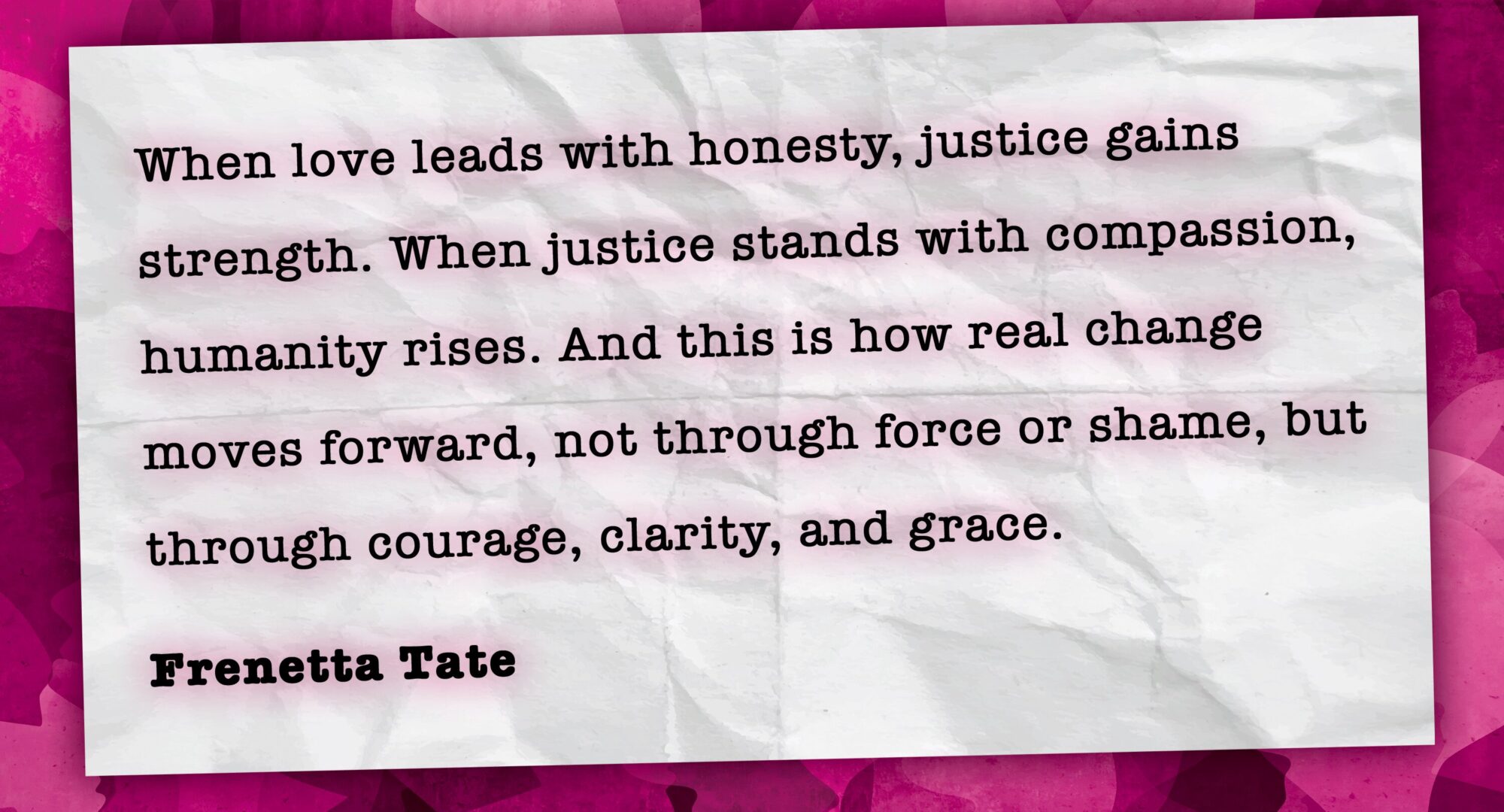
When love leads with honesty, justice gains strength. When justice stands with compassion, humanity rises. And this is how real change moves forward, not through force or shame, but through courage, clarity, and grace.
Summary:
Love and Justice in Society: Embracing Our Shared Humanity explores how love, justice, education, and cultural awareness form the foundation of a more equitable world. The article highlights the importance of human dignity, racial equality, and personal growth, emphasizing that justice is love expressed through responsibility and fairness. By addressing cultural understanding, historical truth, and the need to overcome racial bias, it calls readers to replace fear with curiosity and prejudice with compassion. Through education and self-reflection, individuals can help build a more inclusive, just, and united society rooted in shared humanity.
By Frenetta Tate